
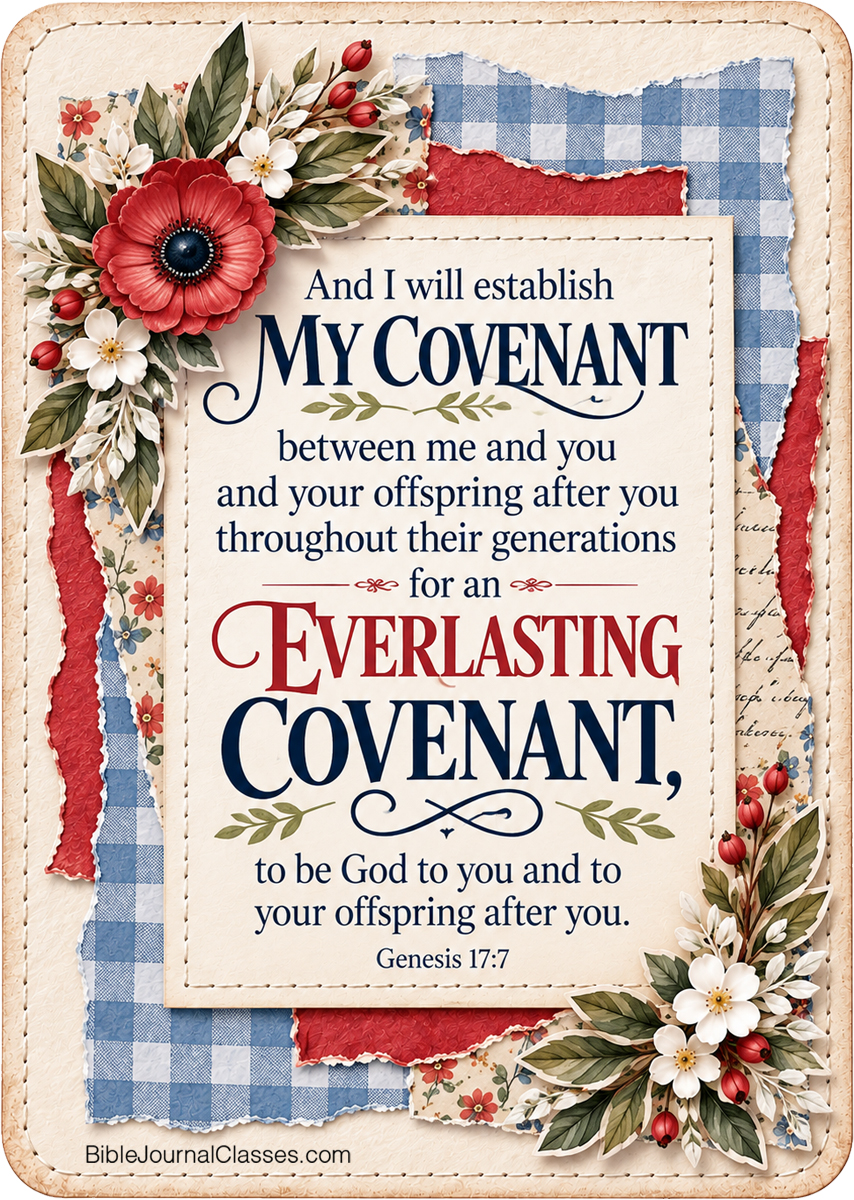
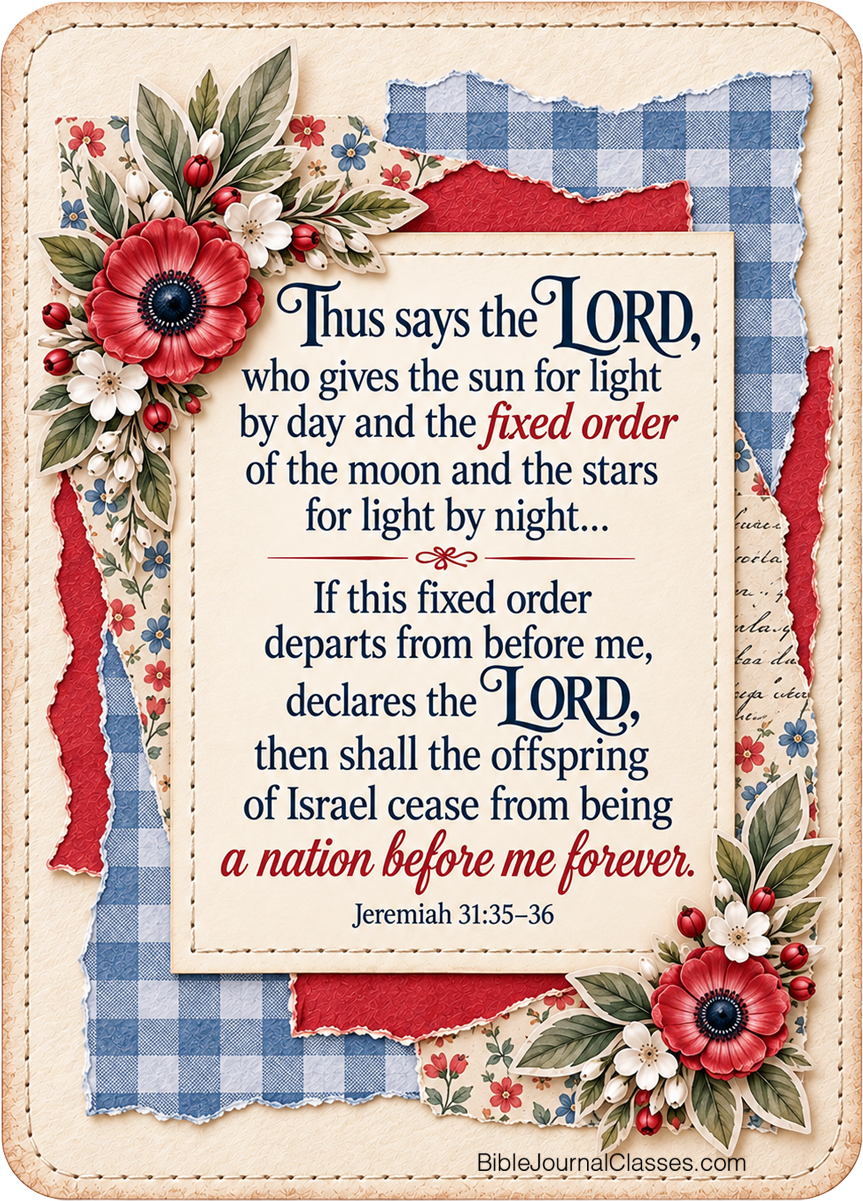
I made these Israel's Promises journal cards as a free gift for you. Each card holds a promise God made to Israel, promises He has never taken back. Tuck them in your Bible at Romans 11, add them to your journal, or set one where you'll see it this week.
My heart is heavy. The headlines and arguments on social media are so loud. Let these cards remind you what God has said. His gifts and His calling are irrevocable.
Link to download the free printable cards are at the end of this post.
Antisemitism is rising again, and Christians need to pay attention. It has many roots: political, cultural, racial, and religious. But one root Christians especially need to examine is replacement theology. It has shaped many churches, even where no one in the pews has heard the term.
 Influential voices such as Tucker Carlson, Candace Owens, Kirk Cameron, and others are bringing arguments about Israel and the Jewish people to huge Christian audiences. Many listeners don't realize they're stepping into a debate that is centuries old.
I've been attacked on social media for being pro-Israel, and one argument I hear again and again is that modern Israel has nothing to do with biblical Israel—that it was simply created by “political operatives.”
But Christians cannot allow modern political arguments to erase thousands of years of biblical history or God's covenant promises. Israel did not begin in 1948. Israel begins in the pages of Scripture.
You can debate the policies of the modern Israeli government. You can debate how the establishment of the modern State of Israel relates to biblical prophecy. Those are legitimate discussions.
But the deeper question is not political. It is biblical: Has God rejected Israel?
Paul answers that question directly: “Has God rejected his people? By no means!” — Romans 11:1
What Is Replacement Theology?
Replacement theology, also called supersessionism, teaches that because Israel rejected Jesus as Messiah, God rejected Israel and replaced her with the Church. The promises God made to Israel now belong to the Church.
We need to be careful with terms. Not every tradition that sees the Church as the fulfillment of Israel's promises believes God has rejected the Jewish people. Hard replacement theology, covenant theology, and fulfillment theology are not the same thing. But historically, the idea that the Church displaced Israel took deep root in Christian thought.

It Didn't Begin That Way
Jesus was Jewish. Mary was Jewish. The apostles were Jewish. The earliest believers were overwhelmingly Jewish.
Paul asked the question Christians have argued about ever since, and then he answered it himself:
"I ask, then, has God rejected his people? By no means! For I myself am an Israelite, a descendant of Abraham, a member of the tribe of Benjamin."
Romans 11:1
Paul doesn't picture Gentiles planting a new tree. He pictures wild branches grafted into an olive tree that was already growing:
"…you, although a wild olive shoot, were grafted in among the others and now share in the nourishing root of the olive tree, do not be arrogant toward the branches. If you are, remember it is not you who support the root, but the root that supports you."
Romans 11:17–18
We didn't replace the tree. We were grafted into it, and the root supports us.
Somewhere along the way, much of the Church forgot that warning.
How Did We Get Here?
After Rome destroyed Jerusalem in AD 70, and especially after the Bar Kokhba revolt (AD 132–135), the Church became more and more Gentile and more and more separated from Jewish communities.
- Justin Martyr (around AD 155–160) called Christians the true Israelite people.
- Origen and others read the promises about Israel, Jerusalem, the Temple, and the land spiritually. They took them as pointing to Christ and the Church rather than to physical Israel.
- Augustine shaped Western Christianity more than anyone. His view was more complex than "God is finished with the Jews," because he believed the Jewish people still served a purpose in God's providence. Still, the Church came to be seen as God's covenant people in a way that left little room for a national future for Israel.
For centuries, that was the dominant view.
Then It Turned Darker
 Theological disagreement is one thing. Hatred of Jewish people is something else entirely. Yet Christian history includes forced conversions, expulsions, and violence against Jews.
Martin Luther is one of the most painful examples. Early on, he hoped Jewish people would embrace the gospel. When they didn't, his writing turned vicious. His 1543 work On the Jews and Their Lies called for destroying Jewish religious life, and many Christian denominations have since condemned those measures.
Replacement theology and antisemitism are not the same thing, and not every act of antisemitism traces back to one doctrine. But we should ask an uncomfortable question: what grows in people's hearts when generation after generation is taught that God rejected the Jewish people?
The Reformation, Dispensationalism, and 1948
The Reformation did not produce one single view of Israel.
- Reformed covenant theology stressed continuity between Israel and the Church. Yet many Reformed believers also read Romans 11 as pointing to a future, large-scale turning of Jewish people to Christ.
- Dispensationalism arose in the 1800s through John Nelson Darby and others. It drew a sharp line between Israel and the Church and expected Israel's promises to be fulfilled in the future. Through prophecy conferences, Bible institutes, and the Scofield Reference Bible, it became hugely influential among American evangelicals.
In 1948, after centuries without a Jewish state, the modern State of Israel was born. Many Christians saw it as prophecy unfolding. Others argued that modern Israel shouldn't automatically be equated with biblical Israel. That debate continues today.
Younger Christians Are Shifting
Recent surveys show a generational gap. Younger evangelicals are much less likely than older ones to say the Jewish people remain God's chosen people. Earlier LifeWay research also found younger evangelicals more likely to agree that the Church has fulfilled or replaced Israel in God's plan.
That doesn't mean every young Christian who questions Christian Zionism holds replacement theology. Criticizing Israeli government policy is not antisemitism. A Christian can criticize an Israeli government without hating Jewish people, and a Christian can reject dispensationalism without believing God rejected Israel.
We need the maturity to tell these questions apart.
 Back to Romans 9–11
Before politics, social media, prophecy teachers, or headlines shape our theology of Israel, we need to read Romans 9–11 for ourselves, all three chapters.
"God has not rejected his people whom he foreknew."
Romans 11:2
"For the gifts and the calling of God are irrevocable."
Romans 11:29
Christians won't agree on every question about modern Israel. The Israeli government isn't beyond criticism, and not every Old Testament promise is easy to interpret. But theological disagreement must never become contempt for the Jewish people.

We worship Israel's Messiah. We read a Bible written overwhelmingly by Jewish authors. We've been grafted into a story that began long before us.
Paul's warning to the Gentile Church is as timely now as when he wrote it:
"So do not become proud, but fear."
Romans 11:20
When antisemitism rises, Christians should be the first to recognize it, reject it, and remember the humility Paul asked of those of us who have been grafted in.
How to Get the Free Cards
The download is located in my Freebies Library! You'll find lots of fun extras waiting for you there. Just a heads up — you'll need to be logged in to see everything available.
Joining is completely free — just pop in your email to get access. And don't worry, we won't flood your inbox: you'll hear from us about once a month, unless there's a special freebie.