 I want to tell you something that might surprise you. For many years, I attended a KJV-only church.
I wasn't there by choice, and I never believed what they taught. Week after week, I heard that the King James Version was the only true Bible in English and that every other version was corrupted. Deep down, I knew something wasn't right.
So I started studying for myself. I love God's Word, and I wanted to understand how it really came to us. That study has lasted more than 20 years. It took me through church history, ancient manuscripts, the translators' own notes, and the stories of people who gave their lives so we could read the Bible in our own language.
What I found didn't shake my faith. It deepened it.
Today I use the English Standard Version (ESV) in my lessons, journals, and kits. Every so often, a dear sister in Christ writes to tell me she can't use my materials because they aren't KJV. I understand where that conviction comes from. I sat under that teaching for years. So I want to share, gently, why I don't hold that view.
"The grass withers, the flower fades, but the word of our God will stand forever." Isaiah 40:8
What KJV-Only Believers Get Right
 Before I share where I disagree, I want to honor what is good in this view.
- They love God's Word. They want to protect it from anyone who would twist or water it down. That's a good instinct.
- They take God's promises seriously. God really did promise to preserve His Word. They're right to believe it.
- They value beauty and memory. The KJV is a treasure of the English language. Generations hid its words in their hearts.
- They're wary of loose paraphrases. Some modern versions do drift far from the original wording. Caution is wise.
So this isn't a debate between people who love the Bible and people who don't. We agree on whether God preserved His Word. We disagree on how He did it.
Where the KJV-Only View Falls Short
Here are seven things I learned that changed my thinking.
1. The KJV translators didn't hold this view
This one surprised me most. The 1611 KJV opened with a long preface called "The Translators to the Reader." Most modern printings leave it out.
In it, the translators said a variety of translations helps readers find the sense of Scripture. They said even the plainest English translation still "is the word of God." They also printed thousands of notes in the margins with other possible wordings. They never claimed their work was perfect or inspired. They saw themselves as humble craftsmen, polishing work others had begun.
2. The KJV itself has been revised
The KJV didn't fall from heaven in 1611. It was built on earlier English Bibles, especially William Tyndale's. About 80 percent of the KJV New Testament comes from Tyndale's work.
After 1611, it was revised several times. Most KJV Bibles today follow the 1769 edition, which updated spelling, punctuation, and some wording. The original 1611 also included the Apocrypha.
That raises a gentle question: if the KJV is the one perfect Bible, which edition is it?
 3. The Greek text behind the KJV had its own weak spots
The KJV New Testament rests on a Greek text called the Textus Receptus. A scholar named Erasmus put it together in 1516, working quickly from a handful of late manuscripts.
His copy of Revelation was missing the last few verses. So he translated them back into Greek from the Latin Bible. That's why Revelation 22:19 says "book of life" in the KJV, while the Greek manuscripts say "tree of life."
The well-known Trinity wording in 1 John 5:7 was added in a later edition of Erasmus's text. It has almost no support in Greek manuscripts. (The Trinity, of course, is taught clearly throughout Scripture without it.)
4. "Omitted" assumes the KJV is the standard
People often say modern versions "remove" verses. But that only works if the KJV is the measuring stick.
When older manuscripts don't contain a verse, it's just as fair to ask whether a later copyist added it. Honest translators note these places. The ESV still prints verses like Acts 8:37 in the footnotes, so nothing is hidden. You can see it and weigh it yourself.
5. We have far more evidence than in 1611
Think of it like a family photo album. In 1611, the translators had a few pictures taken late in life. Since then, we've found baby pictures.
Codex Sinaiticus was found in 1844. Early papyri from the 100s and 200s have been discovered. The Dead Sea Scrolls were found in 1947, giving us Old Testament copies about a thousand years older than any known before. Today we have around 5,800 Greek New Testament manuscripts. Erasmus had only a few.
These older copies don't threaten God's Word. They show how faithfully He preserved it.
6. God's promise to preserve His Word isn't tied to one translation
 God promised His Word would stand forever. I believe that with all my heart. But Scripture never says He would preserve it in one English translation made in 1611.
Psalm 12:6–7 is often used to support the KJV-only view. Even scholars who love the KJV debate whether verse 7 refers to God's words or God's people. Either way, it says nothing about a specific translation.
This also raises a hard question. Where was God's pure Word before 1611? And where is it for believers who don't read English?
7. No core doctrine changes
This is the most comforting truth of all. The deity of Christ, the Trinity, salvation by grace through faith, the cross, and the resurrection all shine clearly in both the KJV and the ESV.
The differences between manuscripts are real. But they don't touch the heart of the gospel.
An Analogy
Grandma wrote her pie recipe by hand. Years later, someone typed up a copy, with a few small mistakes. Then the handwritten original turns up in an old trunk. KJV-only logic says the typed copy is the true recipe and Grandma’s handwriting is the “corrupted” one.
Why I Chose the ESV
 When I set the KJV-only view aside, I didn't want to swing to a loose paraphrase. I wanted a Bible that was faithful, accurate, and still easy to read. For a while I used the NIV but eventially switched to the ESV.
- It's word-for-word. The ESV aims to translate the original Hebrew and Greek as closely as English allows. It doesn't rewrite Scripture in casual language.
- It's part of the KJV family. The ESV (2001) comes from a line of revisions that trace straight back through the American Standard Version to the King James and Tyndale. Its translators saw themselves continuing that legacy, not replacing it.
- It draws on the oldest manuscripts. It uses the best evidence God has preserved for us, including copies found long after 1611.
- It's honest in the footnotes. Where manuscripts differ, the ESV tells you. Nothing is hidden.
- It's clear for today's readers. Many of my students are moms, grandmothers, and new believers. I want them to understand what they read without a dictionary of old English.
I still love the KJV and its beautiful language. Choosing the ESV wasn't rejecting the KJV. It was choosing the best tool for teaching God's Word today.
10 Accusations Against the ESV that Don’t Hold Up
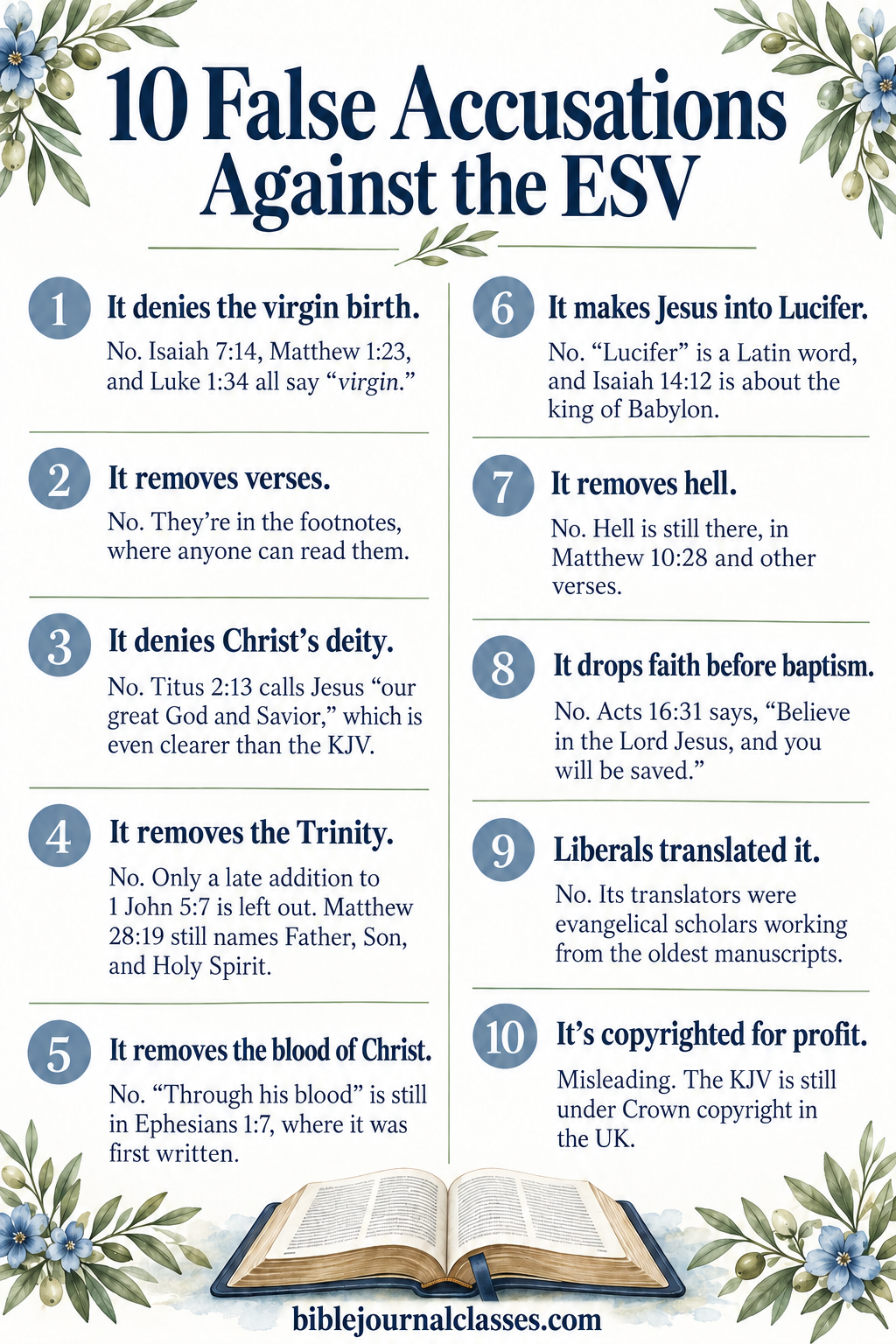
1. “The ESV denies the virgin birth.”
False. The ESV says “virgin” in every key passage. The RSV that the ESV revised had “young woman” in Isaiah 7:14, and the ESV translators changed it back to “virgin.” In Luke 2:33, “his father” follows the oldest manuscripts, and the KJV itself calls Joseph Jesus’s father in Luke 2:48: “thy father and I have sought thee sorrowing.”
“Behold, the virgin shall conceive and bear a son, and shall call his name Immanuel.” Isaiah 7:14
“How will this be, since I am a virgin?” Luke 1:34
2. “The ESV removes verses.”
False. Verses missing from the oldest manuscripts are printed in the footnotes, where anyone can read them.
3. “The ESV denies Christ’s deity.”
False. In some verses it says it more directly than the KJV does. The KJV reads “the great God and our Saviour Jesus Christ,” which can sound like two persons. The ESV makes clear that Jesus is God.
“waiting for our blessed hope, the appearing of the glory of our great God and Savior Jesus Christ,”
Titus 2:13
4. “The ESV removes the Trinity.”
False. Only the late addition to 1 John 5:7 is left out. The Trinity is taught clearly elsewhere.
“baptizing them in the name of the Father and of the Son and of the Holy Spirit,” Matthew 28:19
5. “The ESV removes the blood of Christ.”
False. In Colossians 1:14, “through his blood” was copied over from Ephesians in later manuscripts. The ESV keeps it in Ephesians, where it was originally written.
“In him we have redemption through his blood,” Ephesians 1:7
6. “The ESV makes Jesus into Lucifer.”
False. “Lucifer” is a Latin word that came from the Vulgate. Isaiah 14:12 is addressed to the king of Babylon, and the ESV translates the Hebrew as “Day Star.” Jesus is called the “morning star” in Revelation 22:16, but that uses a different Greek word in a different context.
7. “The ESV removes hell and softens sin.”
False. The ESV uses “hell,” and in 1 Corinthians 6:9 it names sin more directly than the KJV does.
“Rather fear him who can destroy both soul and body in hell.” Matthew 10:28
8. “Removing Acts 8:37 removes faith before baptism.”
False. The ESV teaches salvation through faith throughout.
“Believe in the Lord Jesus, and you will be saved,” Acts 16:31
9. “The ESV was translated by liberals from corrupt texts.”
False. It was translated by a team of evangelical scholars who hold to the authority of Scripture, working from the oldest manuscripts available.
10. “The ESV is copyrighted, so it’s just made for profit.”
Misleading. The KJV is still under Crown copyright in the United Kingdom. Copyright protects the accuracy of a text. It doesn’t make the text corrupt.
 Examine the Fruit
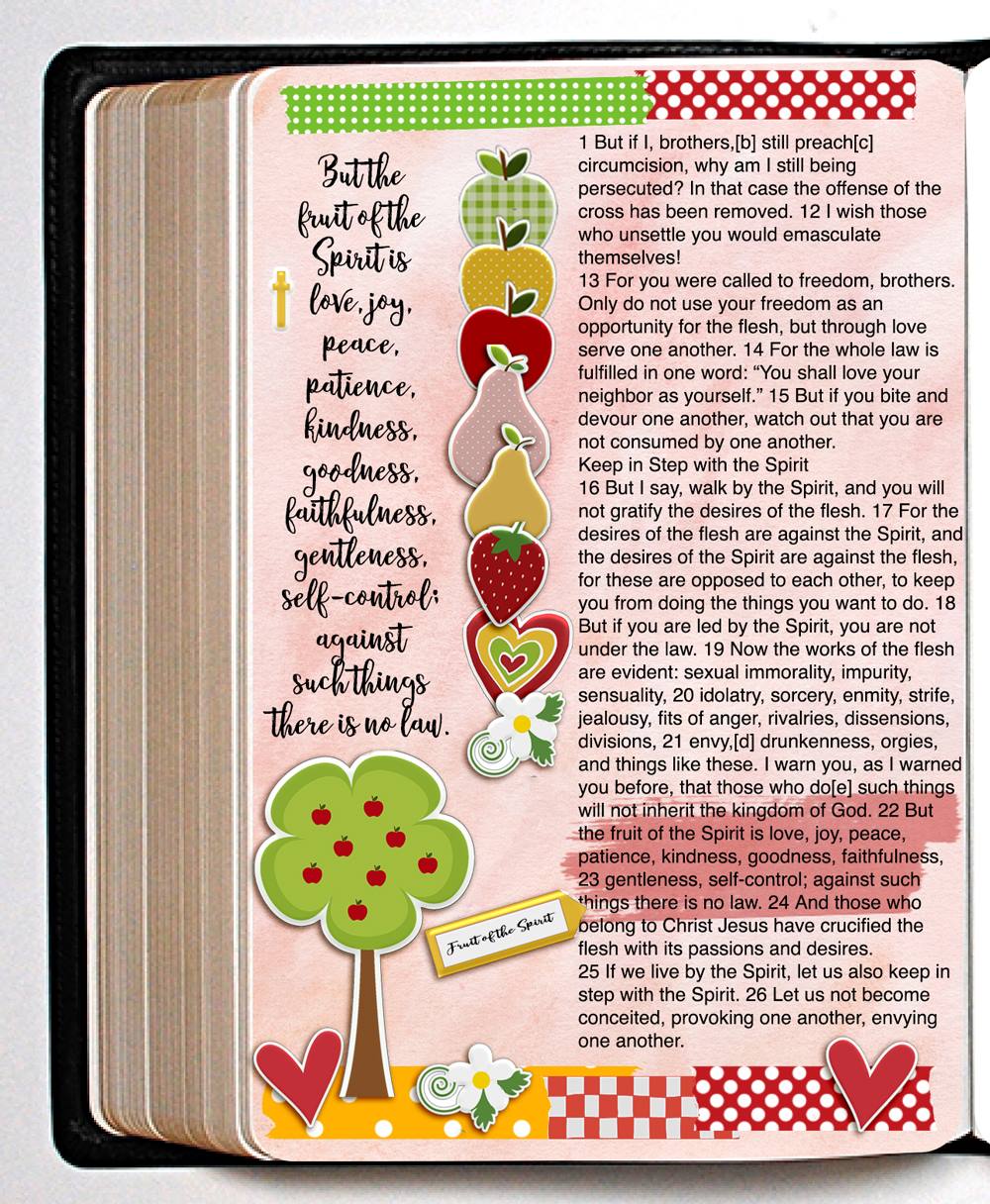
Jesus gave us a simple test for any teaching: look at the fruit. Ask yourself how this teaching is shared. Is the pastor loving, kind, and patient? Or is he condemning and angry toward anyone who reads a different Bible? Does the teaching draw people closer to Jesus, or does it breed fear, pride, and division? The fruit of the Spirit is love, joy, peace, patience, kindness, gentleness, and self-control. Any teaching that truly comes from God will grow that fruit, not harshness toward fellow believers.
There was never good fruit from the KJV Only pastor I sat under. He was full of anger and hate. They church even screamed "Burn it" when another Bible versions was mentioned.
The only books in the pasors bookself were by KJV Only people like Peter S. Ruckman and Gail Riplinger. Leave serious gaps in his teaching and judgment.
"You will recognize them by their fruits." Matthew 7:16
How I Study for Bible Classes
When preparing lessons for my Bible journaling classes, I use Logos to compare several translations side by side. Seeing how each one words the same passage helps me study it more closely and explain it more clearly.

I also consult a Jewish translation to better understand Jesus in his historical setting, from a first-century Jewish perspective

Grace for One Another
If you're KJV-only, I want you to hear this clearly: I respect you. You love God's Word, and so do I. I would never want you to use anything that troubles your conscience. Paul reminds us in Romans 14 to treat each other with grace on matters where sincere believers land in different places.
If you'd still like to use my journals and kits, you're welcome to write your favorite KJV wording right beside the printed verse. Comparing translations side by side can be a rich study all by itself.
And if you're somewhere in the middle of this question, don't be afraid to study it. Read the history. Ask hard questions. Truth doesn't fear an honest search. God's Word has stood through every century, every copyist, and every translation. It will stand through your questions too.
"eager to maintain the unity of the Spirit in the bond of peace." Ephesians 4:3
Whatever translation sits open on your table this morning, my prayer is the same: that it leads you closer to the One it was written about.